Our Microgel-Based Organoid Models

Cardiac Organoids
Sensory and Motor Neuron Spheroids
Sensory and Motor Neuron Spheroids
Human iPSCs assemble, expand, and differentiate within a defined microgel-based environment, producing reproducible 3D cardiac models that exhibit key features of human heart tissue and are suitable for studies of cardiac development, disease, pharmacological responses, and toxicity testing.

Sensory and Motor Neuron Spheroids
Sensory and Motor Neuron Spheroids
Sensory and Motor Neuron Spheroids
From human iPSCs to functional neural networks, our microgel technology enables the reproducible generation and analysis of human sensory and motor neurons. The platform provides a powerful tool for regenerative medicine, drug discovery, and neural tissue engineering.
Process Workflow of Cardiac Organoids
High Throughput Automated Production
Celloreon enables high-throughput, automated production of cardiac organoids using chemically defined, vitronectin-functionalized PEG microgels. Human iPSCs self-assemble into uniform 3D cardiac constructs in standard multi-well formats (96- and 384-well plates), fully compatible with automated liquid handling systems. This scalable workflow ensures high reproducibility, controlled tissue architecture, and homogeneous cardiomyocyte differentiation, while enhanced oxygen and nutrient diffusion supports stable, synchronized beating without necrotic core formation, making it ideally suited for large-scale drug screening, cardiotoxicity testing, and disease modeling.

High Content Screening and Data Analysis
Our cardiac organoid platform is fully compatible with high-content screening and quantitative data analysis workflows. The uniform size, defined composition, and reproducible architecture of the organoids enable robust imaging, functional readouts, and automated analysis of cardiac structure, contractility, and molecular markers. This consistency supports reliable multiparametric data generation across large sample numbers, facilitating scalable phenotypic screening, cardiotoxicity assessment, and data-driven decision-making in drug discovery and disease modeling.

Applications and Potentials
Our cardiac organoids provide a physiologically relevant and scalable human heart model for drug discovery, cardiotoxicity screening, and disease modeling. The chemically defined, microgel-based architecture ensures high reproducibility, uniform cardiomyocyte differentiation, and stable functional readouts such as synchronized beating and calcium dynamics. This makes the platform particularly well suited for high-throughput compound screening, mechanism-of-action studies, and reduction of animal testing, while offering strong translational relevance for early-stage cardiac safety assessment and personalized medicine approaches.
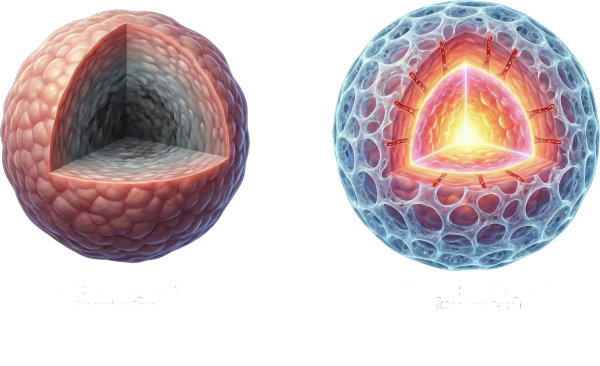
Advantages
The primary advantage of this approach is its chemically defined and xeno-free nature, which eliminates the batch-to-batch variability common in biologically derived materials like Matrigel. Furthermore, the microgels act as a "mock vasculature," significantly enhancing oxygen and nutrient diffusion to the center of the millimeter-scale constructs, which prevents necrotic core formation, a major limitation in traditional organoid models.

Sensory and Motor Neurons
Sensory and motor neurons are essential components of functional neural circuits. Sensory neurons transmit information from the body to the central nervous system, while motor neurons carry signals from the brain and spinal cord to muscles and other target tissues. Despite working together, these cell types differ significantly in their development, regenerative capacity, growth behavior, and interactions with biomaterials. Using human iPSC-derived sensory and motor neuron spheroids, we study these differences to create more physiologically relevant models for neural tissue engineering and regenerative medicine
Process Workflow of Sensory and Motor Neuron Spheroids

High Throughput Automated production
Our microgel-based platform enables the automated and scalable production of sensory and motor neuron spheroids. The microporous microgel environment supports cell growth, differentiation, and tissue organization while ensuring efficient nutrient and oxygen transport. Combined with automated workflows, this technology delivers highly reproducible neural tissues suitable for large-scale screening, biomaterial testing, and regenerative medicine applications.

High Content Screening and Data Analysis
The microgel platform enables systematic analysis of neuronal growth, maturation, neurite formation, and cell-material interactions. Using advanced imaging and automated data processing, we quantify how different biomaterials, coatings, and culture conditions influence sensory and motor neuron development. This high-content approach generates robust datasets that accelerate biomaterial optimization, therapeutic development, and fundamental neuroscience research.

Applications and Potentials
Our microgel-based technology provides a versatile platform for neural tissue engineering, disease modeling, and regenerative medicine.
Applications include:
- Spinal cord injury and neural regeneration research
- Biomaterial and scaffold development
- Drug discovery and toxicity screening
- Patient-specific disease models
- Neuromuscular and multicellular assembloid systems
By combining human iPSC-derived neurons with scalable microgel technology, we create physiologically relevant neural models that bridge the gap between laboratory research and clinical translation.
Advantages